review
Currensea Review (2026): The Travel Card That Works From Your Existing Bank Account
Independently checkedNo paid placement6 sources citedHow we rate
Disclosure: Some links below are affiliate links — if you open an account through one, we may earn a commission at no extra cost to you. It never affects our rankings; we rank on the researched numbers alone. How we rate providers.
Most travel cards ask you to open yet another account, top up a balance, and remember to manage it. Currensea’s whole pitch is that it doesn’t. It’s a Mastercard debit card that sits on top of the UK bank account you already have — you spend abroad, and the money leaves your normal account by Direct Debit, just without your bank’s usual foreign-transaction markup.
That one design decision is why it keeps topping “best travel card” lists for UK travelers — and it’s also the source of its hard limits. Here’s the full picture, with every fee checked against Currensea’s own pricing and help pages on 3 July 2026.
How we verified this review: every fee and limit below comes from Currensea’s official pricing, rates and help pages (linked in Sources), checked 3 July 2026. Worked costs are modelled from those published fees — your exact cost depends on the day’s rate — so confirm on Currensea’s own pricing page before you commit. We take affiliate commissions but never payment for rankings. How we rate providers.
How Currensea actually works
- You link your existing UK bank account (about two minutes, via the app). Currensea works with all major UK banks — Barclays, HSBC, Lloyds, Halifax, NatWest, RBS, Santander, Nationwide, TSB, First Direct, Virgin Money, Monzo and Coutts among them.
- The card arrives in ~5 working days. It’s a Mastercard debit card, works in 180 currencies, and supports Apple Pay and Google Pay.
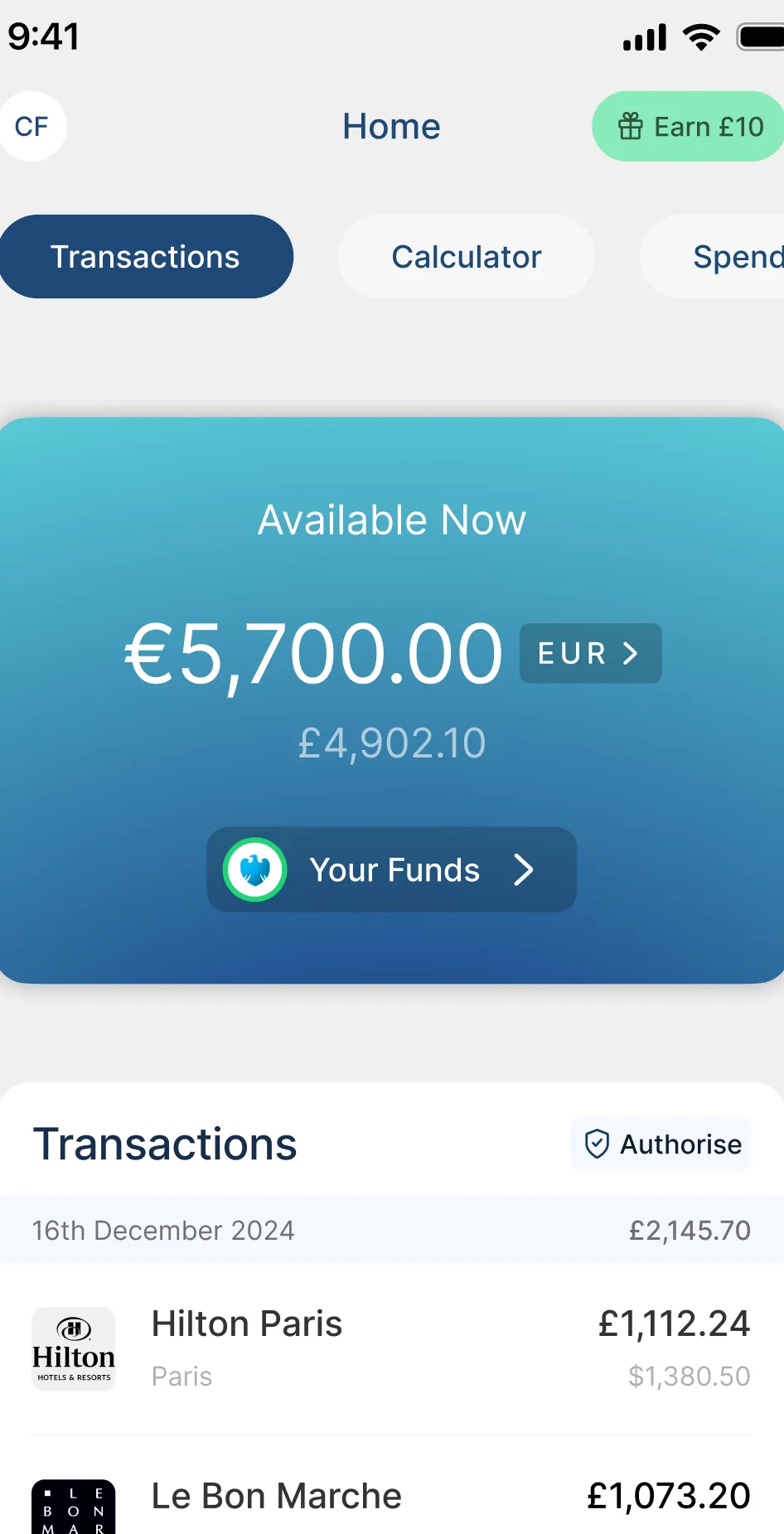
- You spend abroad as normal. Currensea converts at its rate (details below) and settles the sterling amount from your bank account by Direct Debit. No preloading, no separate balance, no “oops, my travel card is empty” moment at a foreign checkout.
The key mental model: Currensea is not a bank and never holds your money. It’s a payment layer over your existing account — which is precisely why it’s so low-effort, and why it can’t do the things a real account does (hold currencies, receive payments).
The fees (checked 3 July 2026)
Currensea restructured its plans in 2026, so ignore older reviews that mention a “£25 Premium plan” — the current line-up is Essential, Pro and Elite:
| Essential (free) | Pro (£39.95/yr) | Elite (£150/yr) | |
|---|---|---|---|
| Annual fee | £0 | £39.95 | £150 |
| Card delivery | £4.95 (free under a limited-time offer as of July 2026) | Free | Free |
| Exchange rate (16 major currencies) | Interbank + 0.5% (“Realtime Rate”) | Interbank, 0% markup (“Pro Rate”) | Interbank, 0% markup |
| Fee-free card spend | First £500/month, then a 1% fee applies | Unlimited | Unlimited |
| ATM abroad, fee-free | £200/month, then 2% | £500/month, then 1% | £750/month, then 1% |
| Other currencies | Mastercard exchange rate — check Currensea’s rates page for your currency | Same | Same |
Three things worth pulling out of that table:
- The 0.5% on Essential is the honest, visible cost. Currensea publishes it plainly: that markup (plus paid subscriptions) is how it makes money. Compare that with high-street debit cards, which Currensea’s own comparison pegs at over 3% once non-sterling fees stack up.
- Essential’s £500/month spend cap is the fee that catches people. Under it, you pay 0.5%. Over it, a 1% fee kicks in. For a two-week holiday with modest spending you’ll likely never notice; for a month-long trip or regular travel, you will.
- Pro pays for itself at roughly £8,000/year of foreign spend (£39.95 ÷ 0.5%) — sooner if you regularly blow past Essential’s £500 monthly cap. Below that, stay on Essential and keep the £39.95.
A modelled example: one week abroad
Say you put £400 on the card and withdraw about £170 in cash during a week in Spain (both within Essential’s monthly caps):
- Currensea Essential: 0.5% on both ≈ ~£2.85 total.
- A typical high-street debit card, using the 3%+ that Currensea’s comparison cites for non-sterling charges: ~£17+, before any per-withdrawal ATM fees your bank adds.
Modelled from published fees, not a live test — but the gap is the whole product. Currensea claims its Essential customers save an average of £43 a year in FX fees (its own figure, for its own average customer — heavier travelers save more, and that’s exactly whom the paid plans target).
The cons, stated plainly
- UK-only. No UK bank account with Direct Debit, no Currensea. Non-UK readers: start with Currensea vs Wise vs Revolut — the other two are available in most countries.
- Essential’s caps bite regular travelers. £500/month fee-free spend and £200/month of ATM cash is holiday-sized, not nomad-sized.
- It can’t receive or hold money. No IBAN, no currency balances, no getting paid by foreign clients. If any part of your problem is income across borders, you want a multi-currency account, not this.
- Approval isn’t guaranteed. Users on Trustpilot report occasional rejections at the bank-linking stage.
- Support gets mixed reviews. The overall Trustpilot rating is Excellent (roughly 22,000 reviews as of July 2026 — see the live score), but slow customer service is the recurring complaint among the negative ones.
- Cash-heavy travelers should look elsewhere — the ATM allowances are the least generous part of every plan.
Is Currensea safe?
Safer, structurally, than most fintech cards — for one specific reason: your money never sits with Currensea. It stays in your own bank account, with your bank’s existing FSCS protection, until each transaction settles by Direct Debit. There is no Currensea balance to worry about because there is no balance at all.
On the regulatory side: Currensea Limited is authorised and regulated by the Financial Conduct Authority for payment services under the Payment Services Regulations 2017 (FCA reference 843507 — you can verify it on the FCA register). It’s a Principal Member of Mastercard, and purchases carry Mastercard chargeback protection. One nuance: as a debit card, that’s chargeback — not the Section 75 protection you’d get from a credit card.
Who it’s for — and who it isn’t
For you if: you bank in the UK, you travel a few times a year, and you want the cheapest possible version of “just use my normal card” abroad. Essential does that for free. If you’re a frequent traveler spending £500+ in most months away, Pro’s flat £39.95 with zero markup and unlimited fee-free spend is the better math.
Not for you if: you’re outside the UK; you’re a freelancer or nomad whose real problem is receiving money across borders (Wise vs Payoneer vs Deel is your comparison); or you want one app that does budgeting, holding and investing — that’s the Revolut side of the Currensea vs Revolut question.
If the honest answer for you is “my bank already offers fee-free foreign spending” (a few UK accounts do), use your bank. Currensea’s value is fixing the ~3% that most high-street cards charge — not beating an already-free card.
FAQ
Is Currensea safe? Yes — see above. Your money stays in your FSCS-protected bank account until settlement; Currensea is FCA-regulated for payment services (ref 843507) with Mastercard chargeback on purchases.
How does Currensea make money if the card is free? The 0.5% Essential markup and the Pro/Elite subscriptions. That’s the published model — no hidden spread beyond it.
Which banks work with Currensea? All major UK banks — Barclays, HSBC, Lloyds, Halifax, NatWest, RBS, Santander, Nationwide, TSB, First Direct, Virgin Money, Monzo, Coutts.
Can I use Currensea outside the UK? You can spend worldwide (180 currencies), but you must have a UK bank account to get it. Non-UK residents should compare Wise and Revolut instead.
What does Essential actually cost? £0 annually; £4.95 delivery (waived at the time of checking); 0.5% on the first £500/month of spend, then 1%; ATM fee-free to £200/month, then 2%.
Related guides
- How to get paid & spend across borders without losing 5% — the hub guide
- Currensea vs Wise vs Revolut: which keeps more of your money abroad?
- Currensea vs Revolut: which one is better?
- Currensea for UK travelers: the app in detail
- How we rate providers · Our editorial standards
Sources (checked 3 July 2026)
- Currensea plans & pricing: https://www.currensea.com/pricing/plans
- Exchange rates (16 interbank pairings / Mastercard rate): https://www.currensea.com/rates
- How it works & supported banks, FCA authorisation (ref 843507): https://www.currensea.com/how-does-currensea-work
- Savings claims (up to 85%, average £43/£118/£195 per plan): https://www.currensea.com/
- Trustpilot reviews: https://www.trustpilot.com/review/currensea.com